
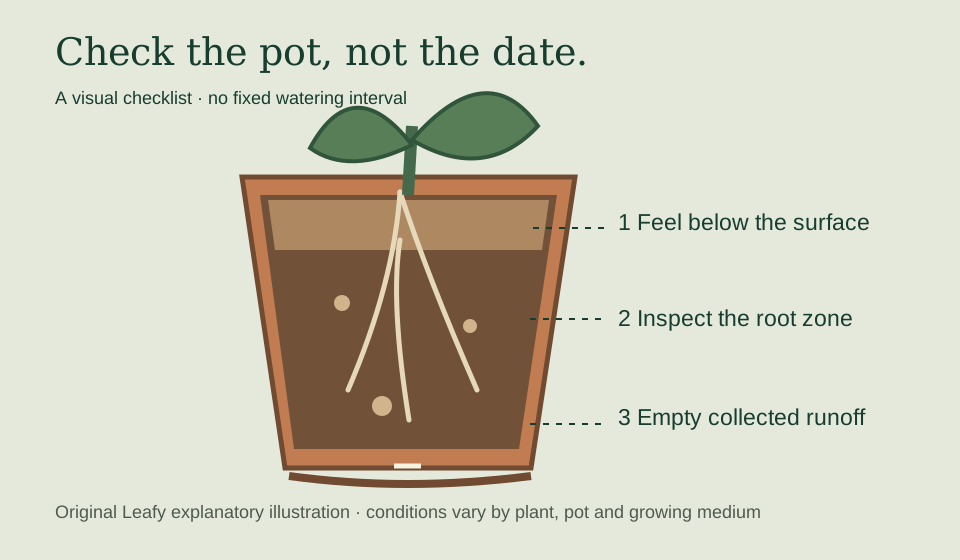
A calendar can remind you to inspect a plant. It cannot tell you that the roots need water. Two identical nursery pots can dry at different rates because of their light, growing medium, root mass, container size, airflow and whether rain enters the pot.
What to check before watering
Assess moisture below the surface, not only a dry-looking top crust. If appropriate, lift the pot to compare its weight just after watering and when drier. Look for free drainage. A decorative outer pot can conceal water that has collected under the nursery pot.
When you water, wet the medium sufficiently and allow the excess to leave the drainage holes. Empty the saucer as needed. A pot without a drainage path makes it more difficult to tell how much water is retained around roots.
The climate is not one setting
PAGASA describes four broad Philippine rainfall types. Conditions in a sheltered air-conditioned apartment, a naturally ventilated room and an unsheltered balcony are different—even in the same city. Rain can saturate a pot while its owner has not watered it at all. In a lower-light place, plant water use can be reduced; heat and moving air can alter drying.
What a leaf cannot tell you by itself
Drooping, yellowing or brown tips are observations, not diagnoses. Check moisture, light, drainage, airflow and recent changes together. Sudden, persistent collapse or decay deserves closer inspection, rather than an automatic extra watering. If pests are present, isolate the plant and use authoritative identification before choosing a remedy.
For species-specific starting points, compare ZZ plant with peace lily: their growth and water-storage habits differ. Use the placement worksheet to create a history instead of relying on a universal date.